


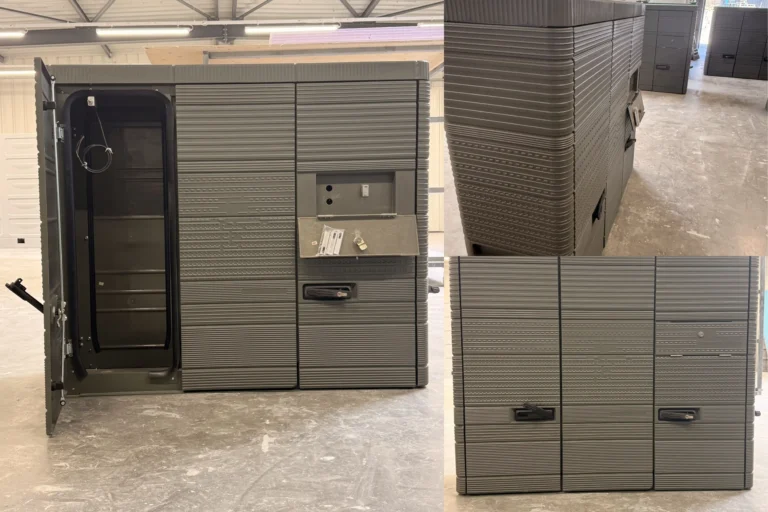
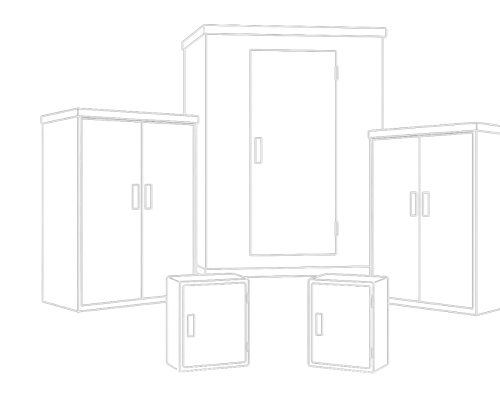
The renewal of urban infrastructure is now a major issue for local authorities. The polyester cabinets installed in public spaces, which protect electrical networks, public lighting or signaling, are designed to last several decades. When they reach the end of their life cycle, their replacement raises a crucial question: what happens to these technical equipment?
For more than ten years, Europoly has been supporting the Métropole Grand Lyon in the deployment of its polyester cabinets for urban infrastructure. During the renewal of part of this park, a process to recover old cabinets was implemented in order to limit waste and promote more responsible management of the equipment left behind.
Why recycle polyester cabinets?
Glass fibre reinforced polyester (GRP) cabinets are known for their excellent mechanical performance and resistance to external stress. They durably protect electrical equipment against bad weather, UV radiation, corrosion or even the most demanding urban environments.
If their lifespan is particularly long, they are not eternal. The evolution of networks, new technical requirements or local authority modernization programs regularly lead to the replacement of certain equipment.
In this context, the recycling and recovery of polyester cabinets is an essential step to reduce the environmental impact of renewal operations.
Beyond waste management, this approach is part of a circular economy logic, aiming to extend the life cycle of materials and limit the use of virgin resources.
The renewal of the polyester cabinets at the Métropole Grand Lyon
As a long-standing partner of the Greater Lyon Metropolitan Area, Europoly has been supplying polyester cabinets for many years to protect the various technical networks installed in the public domain.
The first generations of cabinets have accompanied the development of urban infrastructure for several decades. With the evolution of needs, standards and aesthetic criteria, some installations have gradually been replaced by new models more adapted to current expectations.
This renewal also represented an opportunity to improve the end-of-life management of deposited equipment.
Rather than systematically directing these cabinets towards a traditional disposal pathway, an overall review was conducted in order to prioritize their use where possible.
This approach perfectly illustrates the willingness of local authorities to combine infrastructure modernization and reduction of their environmental footprint.
A valuation approach integrated into the circular economy
End-of-life management of technical equipment is now a major issue for public stakeholders.
As part of this project, the old polyester cabinets that have been removed are subject to a sorting and recovery process adapted to their condition and composition.
Depending on the case, the different materials can be directed towards specialized sectors in order to promote their reuse or recycling.
This organization allows you to:
- reduce the amount of waste generated during renewal operations;
- promote the valorization of materials when possible;
- limit the consumption of new resources;
- to integrate infrastructure projects into a sustainable environmental approach.
This approach fully contributes to the ecological transition objectives pursued by many local authorities.
Technical cabinets designed to last
Polyester cabinets are widely used to protect electrical equipment installed outdoors.
Thanks to their design in glass fibre reinforced polyester, they have many technical advantages:
- excellent corrosion resistance;
- high UV resistance;
- excellent stability over time;
- high-performance electrical insulation;
- low need for maintenance;
- high resistance to aggressive environments.
These characteristics explain their presence on many public lighting, light signalling, video surveillance, telecommunications and electrical distribution networks.
When they reach the end of their operating cycle, their value represents a natural extension of this logic of sustainability.
A video to discover the project
The project carried out with the Métropole Grand Lyon is a concrete example of this approach to promoting polyester cabinets.
The video below presents the different stages of equipment replacement as well as the actions implemented to promote their recycling and recovery. It also reflects the shared commitment between Europoly and the Métropole Grand Lyon to promote more responsible management of urban infrastructure.
Europoly, partner of local authorities in the renewal of polyester cabinets
Beyond the manufacture of polyester cabinets for electrical networks and urban infrastructure, Europoly supports local authorities in a comprehensive approach that integrates equipment durability and end-of-life.
This vision is fully in line with the current challenges of the circular economy and reducing the environmental impact of development projects.
The partnership developed with the Métropole Grand Lyon illustrates this desire to offer high-performance technical solutions while promoting responsible management of replaced equipment.
To discover another approach to recovering existing equipment, also consult our project dedicated to the reconditioning of polyester cabinets, which presents a project focused on restoring technical cabinets in order to extend their lifespan.