


Installing electrical equipment outdoors comes with one simple rule: water, dust and impacts must never reach the components. That is exactly the job of a waterproof electrical box. It still has to stay waterproof over time, through rain, sun, frost and sometimes sea spray.
Between protection ratings, materials, seals and cable entries, there are plenty of selection criteria. A poorly chosen box often ends up letting moisture in, becoming brittle under UV or rusting around its fixings. And failures always happen at the worst possible moment.
In this article, we look at what really makes an electrical box waterproof, which rating to aim for depending on the location, and why glass fibre reinforced polyester (GRP) is often the best choice for outdoor use.
What is a waterproof electrical box?
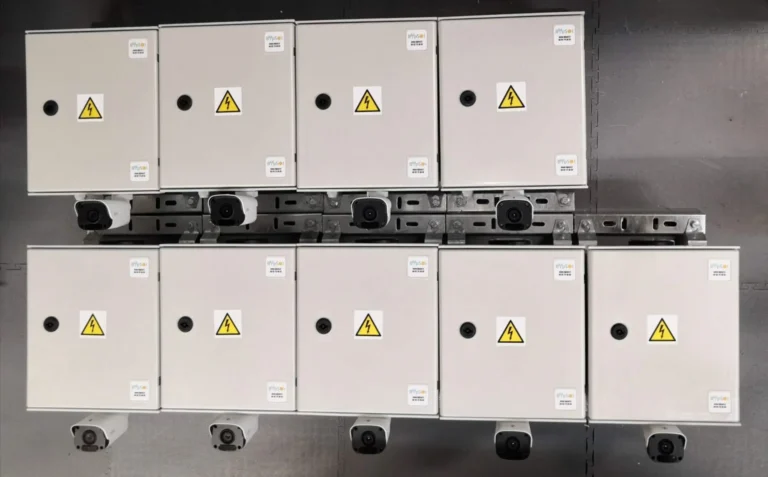
A waterproof electrical box is a closed enclosure that protects electrical devices (circuit breakers, terminal blocks, PLCs, sockets, communication equipment) against the ingress of water and dust. Its level of sealing is measured by the IP rating, and its resistance to impacts by the IK rating.
You will find them in car parks, at the foot of lamp posts, in pumping stations, on solar installations and along railway lines. In every case, the box must protect its contents for years without any intervention.
Not to be confused with a cabinet: a box is more compact and is usually fixed to a wall or a post, whereas a cabinet stands on the ground and houses more equipment. If your project needs more space, our article on the waterproof or ventilated electrical enclosure will help you choose.
Which IP rating for an outdoor electrical box?
The IP rating is made up of two digits: the first indicates protection against solid objects and dust, the second protection against water. Each level is detailed on our IP and IK protection ratings page and on the IEC page dedicated to IP ratings.
For a box installed outdoors, here are the most common benchmarks:
| Rating | Protection | Recommended use |
|---|---|---|
| IP44 | Objects larger than 1 mm, water splashes | Sheltered location (canopy, covered area) |
| IP54 | Dust (limited ingress), water splashes | Lightly exposed outdoor area, open plant room |
| IP55 | Dust, water jets | Outdoors, exposed to driving rain |
| IP65 | Dust tight, water jets | Exposed outdoor area, dusty environment |
| IP66 | Dust tight, powerful water jets | Seaside, roads, areas cleaned with a hose |
| IP67 | Dust tight, temporary immersion | Flood prone areas, underground pits |
For sheltered or lightly exposed equipment, a lower rating can be enough. For a box permanently exposed to the weather, to dust or to hose cleaning, it is better to aim for IP65 or IP66: this is the standard level for industrial installations and public equipment.
Don’t forget the IK rating
The IK rating measures resistance to mechanical impacts, from IK00 to IK10. An IK10 box withstands an impact of 20 joules, the equivalent of a 5 kg mass dropped from 40 cm. On public roads, in car parks or in areas exposed to vandalism, this is the level to demand: a cracked box is no longer waterproof, whatever its IP rating.
Plastic, metal or polyester: which material should you choose?
The IP rating is measured on a new box. Outdoors, what matters is its ability to keep that level of sealing after years of sun, frost and rain. And that depends first and foremost on the material.
Plastic boxes (ABS, polycarbonate)
Light and inexpensive, they are suitable for small, sheltered applications. In full sun, some plastics become brittle and yellow over time, which weakens the hinges, the fixings and the door.
Metal boxes
Steel offers excellent mechanical strength, but it remains vulnerable to corrosion as soon as the paint or galvanising is scratched, cut or drilled for a cable entry. Stainless steel performs better, at a much higher cost. We explain these differences in our comparison polyester vs stainless steel enclosure.
Glass fibre reinforced polyester boxes
Glass fibre reinforced polyester combines the best of both: it does not rust, it resists UV and chemicals, and it keeps its rigidity over time. It is also an electrical insulator, which makes it easier to build class II equipment without earthing the enclosure. For exposed outdoor installations, it is the most durable material. You will find more details on its properties in our article on polyester electrical enclosures.
What really makes a box waterproof
An IP66 rating on the data sheet is not enough. In the field, sealing depends on several details:
- The door seal: a moulded or continuously poured seal ages better than a glued seal, which can come away as the door is opened and closed;
- Cable entries: every hole must be fitted with a cable gland suited to the cable diameter and with the same IP rating as the box;
- Locking: a lock or multi point fastenings apply even pressure on the seal;
- Mounting: a box fixed to a warped support can twist the door and leave a gap;
- Rain protection: a roof or canopy prevents water from pooling on top and limits heating in the sun.
Remember that the IP rating of a box is that of its least protected component. An IP66 box fitted with an IP54 cable gland becomes, in practice, an IP54 box.
Waterproof does not mean free from moisture
This is the most common mistake. A perfectly sealed box stops water getting in, but it also traps the moisture already present in the air. When the temperature drops at night, that moisture condenses on the walls and on the components.
To prevent this, there are several solutions: an anti-condensation heater controlled by a thermostat or hygrostat, a membrane breather that balances the pressure without letting water in, or suitable ventilation if the equipment generates heat. Our article on ventilating an outdoor electrical enclosure explains these options.
Waterproof electrical box: the most common uses
| Application | Recommended rating | Key points |
|---|---|---|
| Street lighting and roads | IP65 IK10 | Vandalism, impacts, UV |
| Pumping or lifting station | IP66 IK10 | Constant humidity, corrosive atmosphere |
| Solar installation | IP65 or IP66 | Heat, UV, condensation |
| Seaside | IP66 | Salt mist, corrosion |
| Telecom and fibre networks | IP55 to IP66 | Frequent access, security |
| Construction sites and events | IP44 to IP65 | Handling, impacts |
To go further on some of these cases, read our articles on the outdoor PV cabinet and on the site distribution box.
Europoly waterproof electrical boxes
Since 1999, Europoly has been manufacturing glass fibre reinforced polyester boxes and cabinets designed for outdoor use and demanding industrial environments.
- Micro Euro and Mini Euro: compact IP66 IK10 boxes for small devices and wall mounted installations;
- Euro Medium: modular boxes for larger electrical panels and automation systems;
- Custom made: dimensions, cut outs, mounting plates and accessories tailored to your project.
If you need a ready to use box, wiring can be entrusted on request to Polyelec, the group company specialising in electrical integration. And when your equipment needs a proper technical room, Gensollen designs polyester cabins.
Frequently asked questions
For a sheltered location, IP44 or IP54 may be enough. For a box exposed to rain, dust or hose cleaning, aim for IP65 or IP66. IP67 is reserved for areas where temporary immersion is possible.
Both are dust tight. IP65 withstands water jets, IP66 withstands powerful water jets, which makes it better suited to highly exposed sites and areas cleaned with a hose.
Yes. Sealing stops water getting in, but the moisture in the trapped air condenses when the temperature drops. An anti-condensation heater controlled by a thermostat or a membrane breather prevents it.
Glass fibre reinforced polyester is the most durable outdoors: it does not rust, it resists UV and chemicals, and it insulates electrically. Plastic suits small sheltered uses, while metal needs protection against corrosion.
Use cable glands suited to each cable and with the same IP rating as the box, check the door seal regularly, always close every fastening and check for moisture during maintenance visits.
Conclusion
A waterproof electrical box should be chosen according to its real location: exposure to rain, sun, impacts and temperature changes. IP and IK ratings set the level of protection, but it is the material and the quality of the seals and cable entries that ensure it stays waterproof year after year.
For outdoor installations and demanding environments, an IP66 IK10 glass fibre reinforced polyester box offers the best balance between protection, durability and maintenance. Do you have a project? Contact our teams to find the right box for your installation.