


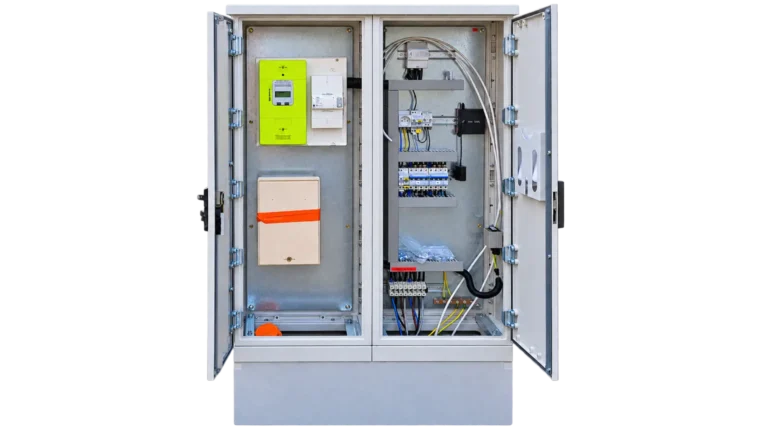
An outdoor meter cabinet houses the metering equipment for an electrical connection and protects it from the elements, impact and corrosion. For a power-monitored connection ranging from 37 to 250 kVA, it must remain accessible at all times to the network operator, who must be able to operate the individual main circuit breaker without the user’s assistance, according to a technical note from Enedis.
This article explains what a meter cabinet contains, what the network operator expects from the enclosure, how glass-fibre-reinforced polyester makes a difference, and how to select and draw up a set of specifications. It also shows how the cabinet and its cabling are designed to work together: Europoly manufactures polyester cabinets with a meter compartment, whilst Polyelec carries out the electrical cabling.
What is a meter cabinet used for?
The role of the cupboard
A meter cabinet is an outer enclosure, mounted on a concrete plinth or foundation, which houses the metering and connection equipment for an electrical installation. It serves two purposes: to protect this equipment and to ensure that network technicians have permanent access to it.
Permanent or site-based meter cabinet
The term covers two distinct concepts. The top results for a search on ‘metering cabinet’ are construction equipment hire companies, which supply distribution and metering cabinets to provide a temporary power supply to a building site or event.
This article discusses the permanent distribution board, which is installed for the lifetime of a connection. For temporary power supply to a building site, the article on single-phase or three-phase site distribution boards sets out the selection criteria.
Yellow tariff, C4, monitored power: understanding the terms
Monitored power connection
A power-monitored connection corresponds to a power rating of 37 to 250 kVA. According to Enedis, it comprises a connection to the grid, an individual main circuit breaker (CCPI) and an individual branch circuit. The connection to the grid is always three-phase with a neutral. It is rated in stages: 100 A for 37 to 60 kVA, 200 A for 60 to 120 kVA and 400 A for 120 to 250 kVA.
Yellow tariff and C4 segment
This particular power range is often referred to as the ‘yellow tariff’ or the ‘C4 segment’. The C4 segment refers to businesses connected to the low-voltage network with a contracted power of between 36 and 250 kVA, fitted with an SME/SMI-type meter. These terms primarily relate to billing. The distribution board, however, depends on the power rating of the connection and the requirements of the network operator.
What’s in the meter box
The meter, modem, test sockets and, where applicable, other equipment are installed on the front panel of the control panel, in accordance with the Enedis guidelines. For new installations, the CCPI is integrated into a meter cabinet that complies with an Enedis specification for power-monitored connections.
Alongside this enclosure, the cabinet often houses the control or distribution section of the equipment: protective devices, contactors and branch circuits. A cabinet manufacturer’s catalogue also distinguishes between control panels in accordance with NF C 14100 and operating panels in accordance with NF C 17200. This internal wiring is Polyelec’s speciality, and the company carries it out within the cabinet manufactured by Europoly.
What the network operator expects from the budget
The Enedis guidelines examined here relate to enclosures containing connection equipment, particularly those located on public land: charging points, kiosks and street lighting cabinets. The rules governing individual connections at property boundaries are set out in standard NF C 14100. These must be approved by the network operator for each project.
Approved equipment and responsibilities
For this equipment, the only connection components that may be used are those approved by Enedis. Enclosures are not generally subject to authorisation for use: their design, installation and maintenance are the responsibility of the equipment owner.
Access and manoeuvring
The same note sets out several rules regarding access:
- the door of the meter box opens to 135 degrees;
- the clear space in front of the CCPI must be at least 80 cm, without encroaching on the carriageway;
- the base supporting the cable reel and the switch must be at least 40 cm above the finished floor level;
- a depth of 400 mm must be provided to accommodate the box, the meter and the metering devices;
- no equipment or pipework must be placed in front of the meter box;
- a panel covering the CCPI must open or be removed easily a
Protection ratings and Class II
For an additional meter integrated into public infrastructure, Enedis requires an enclosure with specifications equivalent to those of its own enclosures, namely IP 43 and IK 10.
The connected panels are Class II. The heads of the fixing bolts are covered with insulating caps, which guarantee a dielectric strength of 4 kV for one minute at 50 Hz. Details of the IP and IK ratings can be found on the IP/IK protection rating page.
Why use polyester for an outdoor meter cabinet?
A meter cabinet remains in place for years, exposed to rain, frost, sunlight and impacts. Glass-fibre-reinforced polyester meets these requirements in several respects.
Corrosion, insulation and finishing
- It does not rust. Its corrosion resistance minimises maintenance and the need for repainting.
- It is electrically insulating. The casing does not conduct electricity, which meets the Class II requirement for meter panels.
- Its surface can be treated. On Europoly cabinets, a surface gel coat improves resistance to chemical and atmospheric attack.
Heat, cold and condensation
When it comes to metering equipment, condensation is a key consideration. It occurs when the walls or internal components are colder than the dew point of the air inside, and can lead to corrosion and insulation faults. A high IP rating does not protect against it. The balance between watertightness and ventilation is discussed in the article ‘Polyester enclosures: ventilation or watertightness’.
Integration into the environment
A meter cupboard is visible from the public area. A guidance note from a departmental architecture and heritage service recommends that connection boxes be integrated into the architecture: they should be the same colour as neighbouring cladding and grouped together with other fittings on a fence.
Other manufacturers offer polyester switchboards for loads up to 250 kVA, with IP55 and IK10 ratings, in RAL 1015 beige or painted in other RAL colours, for use in urban, suburban or rural areas, mounted on a plinth or concrete foundation. To compare enclosures and switchboards, see the page on industrial polyester electrical enclosures.
Criteria for choosing an outdoor meter cabinet
Power capacity and scalability
The current rating (100 A, 200 A or 400 A) determines the equipment to be housed. Enedis recommends allowing for future expansion of the recess, so that a 100 A meter can later be upgraded to a 200 A or 400 A meter without altering the installation. The 200 A and 400 A meter boxes have the same dimensions.
Internal dimensions
They must accommodate the meter box, which is 400 mm thick, with the door opening to 135 degrees, and provide sufficient working space. For example, the polyester cabinets in one manufacturer’s catalogue are 1,250 mm high, 750 or 1,000 mm wide and 420 mm deep.
Fastening and lock
The lock must allow network technicians access at all times. The 11 mm triangular service key, referred to in the Enedis note for panels that conceal the CCPI, is the standard for this.
Installation instructions
These cabinets are installed on a plinth or a concrete foundation. To remove equipment without disconnecting the mains connection, Enedis recommends using a support bracket that can remain in place permanently.
Cabinet and cabling: considering both together
Considering the enclosure and the cabling together makes it possible to determine the dimensions, fixing points, cable entries and connection capacities right from the start. Europoly manufactures the polyester enclosure, whilst Polyelec carries out the internal electrical cabling and electrical integration. The connection and metering equipment remains that approved by the network operator.
Draw up the specifications
A detailed specification helps to avoid repeated correspondence with the network operator. It may include the following points:
- the network operator and the applicable specification;
- the current rating: 100 A, 200 A or 400 A;
- the internal dimensions, including metering and access space;
- a door opening of 135 degrees and a clear space of 80 cm;
- the minimum height of 40 cm for the support plinth;
- the required IP and IK ratings;
- the locking system and operating key;
- the colour and appearance, as stipulated by town planning regulations;
- the installation method: plinth or concrete foundation;
- Internal electrical wiring: scope, diagram and labelling, to be carried out by Polyelec in conjunction with the switchboard.
From counting to the finished product: Europoly, Gensollen and Polyelec
A meter cabinet is sometimes part of a larger system, such as a street lighting cabinet or a plant room. The group’s three companies cater for these requirements.
Europoly, the polyester membrane
Europoly manufactures boxes, cabinets and enclosures made from glass-fibre-reinforced polyester.
Polyelec: cabling and electrical integration
Europoly manufactures the cabinet, whilst Polyelec carries out the cabling: internal electrical wiring and the integration of protective devices, contactors and branch circuits for the control or distribution section. The connection and metering equipment remains that approved by the network operator.
Gensollen, the cabins and facilities
Gensollen designs bespoke industrial polyester enclosures and their fittings: HVAC ventilation, interior fittings and raised floors. This range meets requirements that go beyond a simple cabinet, such as a shelter or a plant room.
Frequently Asked Questions
It houses the meter for an electricity connection, protects it from the elements, impact and corrosion, and remains accessible at all times to network technicians.
According to Opéra Énergie, these terms refer to the power range of 36 to 250 kVA in the low-voltage sector, fitted with a SME/SMI meter. They relate primarily to billing, not to the design of the switchboard.
For an additional meter integrated into public infrastructure, Enedis requires specifications equivalent to those of its enclosures: IP 43 and IK 10. The requirements for a specific project must be confirmed with the network operator.
With regard to public-sector infrastructure, Enedis states that the design, installation and maintenance of the building envelope are the responsibility of the infrastructure owner.
Glass-fibre-reinforced polyester does not rust, is corrosion-resistant and does not conduct electricity. These characteristics mean that very little maintenance is required for a cladding that remains in place for years.
Are you planning to build a meter cabinet?
The Europoly teams will assess your requirements and find the right solution. Discover the full Europoly range or contact an adviser. Polyelec carries out the cabling and electrical integration, whilst Gensollen manufactures the cabins and fits out the interiors.