


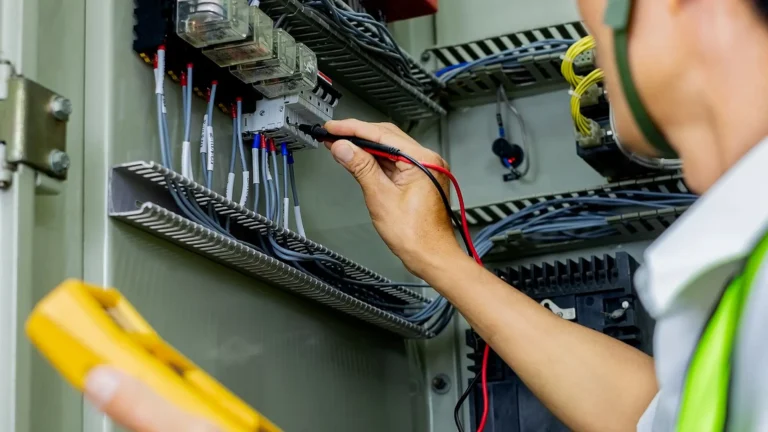
Maintenance of an electrical cabinet is essential to ensure the system remains reliable, to detect any deterioration and to protect the equipment it contains. Humidity, dust, corrosion, temperature fluctuations, solar radiation and the ageing of components can gradually alter the operating conditions of a system.
However, maintenance should not be limited to cleaning or checking electrical components. The condition of the casing itself plays a vital role.
When an enclosure regularly suffers from problems such as corrosion, damp, condensation or water ingress, simply carrying out more maintenance operations does not necessarily address the root cause. It is also necessary to check whether the enclosure used is suitable for its environment.
It is precisely in this regard that Europoly polyester enclosures are of particular interest for outdoor, damp or corrosive environments.
Why is the maintenance of an electrical cabinet essential?
An electrical cabinet houses components that are essential to the operation of a system: electrical protection devices, automation systems, terminal blocks, power supplies, variable speed drives, communication equipment and control devices.
Over time, a number of phenomena may arise:
- dust build-up;
- ageing of seals;
- presence of moisture;
- corrosion;
- blocked ventilation;
- unusual overheating;
- damage to a cable
modification de l’installation non documentée.
Preventative maintenance enables these faults to be identified and corrective action to be planned before they become more serious.
It also makes it possible to check an aspect that is often overlooked: is the cabinet still suitable for its actual operating environment?
A system may have been correctly sized when it was first commissioned, but may then be subjected to new stresses a few years later: a rise in temperature, exposure to corrosive agents, the installation of new equipment or changes in external conditions.
Maintenance checklist for an electrical cabinet
An effective checklist must be tailored to the installation, the manufacturers’ specifications and the company’s safety procedures.
Here are the main points to consider.
| Chekpoint | Items to check | possible faults |
|---|---|---|
| casing | Door, walls, fixing | Impacts, cracks, corrosion |
| Sealing | Seals, cabe glands, penetrations | Water, dust, moisture |
| Wiring | Conduits, conductors, routing | Wear and tear, damage |
| Connections | Terminal, blocks and connections | Overheating, visible faults |
| Thermal | ventilation, filters, temperature | contamination, overheating |
| Documentation | diagrams and layout plans | out of date documents |
| Environment | water, uv, dust, chemicals | inadequate enclosure |
Work must, of course, comply with the relevant regulations on electrical hazards and be carried out by persons with the necessary skills and authorisations, depending on the nature of the work.
1. Check the envelope and its surroundings
Maintenance begins before the cabinet is opened.
Examine its external condition and check for signs of impact, deformation, surface damage, corrosion or an abnormal build-up of contaminants.
Il faut également observer son environnement.
A cabinet installed near a chemical processing plant, by the seaside, in a pumping station or directly outdoors is not subject to the same stresses as a cabinet placed in a clean, temperature-controlled plant room.
If damage recurs regularly despite maintenance work, it may be worth reconsidering the material used for the enclosure.
Europoly’s Euro Medium polyester enclosures are specifically designed for corrosive environments and outdoor installations. They are made from glass-fibre-reinforced polyester, a material that is electrically insulating and does not absorb moisture.
2. Check for watertightness and cable entries
The IP rating of an enclosure corresponds to a specific configuration. Any modifications made whilst it is in use must therefore maintain the required level of protection.
During maintenance, check the following:
- the condition of the door seal;
- the cable glands;
- the plugs;
- the cable entries;
- the locking mechanisms;
- any openings added after installation.
Traces of dust or water inside may indicate that a component needs to be inspected.
The choice of enclosure must also be appropriate for the actual exposure conditions. The Euro Medium Europoly range, for example, offers IP55 or IP65 ratings and IK10 impact resistance in accordance with the standards specified by the manufacturer.
For larger sizes, the Maxi Euro 1500 combines a glass-fibre-reinforced polyester construction, an IP65 protection rating, IK10 impact resistance and a polyurethane coating with high UV resistance.
These features are particularly beneficial when an enclosure needs to remain exposed to outdoor conditions over the long term.
3. Monitoring overheating and ventilation
Temperature is another key aspect of maintenance.
An abnormal rise in temperature may be caused by a piece of equipment, a connection, inadequate ventilation or simply a change in the power dissipation since the initial design.
In particular, the following should be checked:
- filters;
- ventilation grilles;
- fans;
- any heat exchangers;
- temperature sensors;
- visible signs of overheating.
The addition of new components must also be used as an opportunity to check whether the thermal design remains appropriate.
In particularly demanding environments, Europoly can incorporate specific solutions. In the case of a bespoke polyester enclosure manufactured for the Kourou space centre, the design combines, in particular, IP65 protection, IK10 impact resistance, a UV-resistant coating, IP65 ventilation grilles and internal insulation made from high-density polyurethane foam.
Cet exemple montre que la maîtrise des contraintes thermiques commence dès la conception de l’enveloppe.
4. Check the wiring, connections and equipment
The internal inspection must look for any unusual signs of deterioration.
- damaged insulation;
- loose conductor;
- traces thermiques ;
- signs of overheating;
- undocumented modification;
- no identification marking;
Connections must be checked in accordance with the applicable regulations and manufacturers’ recommendations. Systematically retightening connections without following a method is not a universal maintenance rule.
It is also important to ensure that equipment remains easily accessible.
The design of the Euro Medium facilitates integration thanks to numerous inserts at the rear of the cabinet, allowing equipment to be mounted directly. The doors are removable and adjustable, whilst the ab
This approach can facilitate both the initial integration and future interventions.
5. Address the issues rather than simply glossing over them
Cleaning the interior is part of maintenance, but it should always prompt an investigation into the source of the contamination.
A large amount of dust that reappears quickly may indicate a problem with the filtration system, a seal or a cable entry point.
The same applies to damp.
If condensation or water appears regularly, you should investigate the cause rather than simply cleaning the cabinet.
In certain applications, thermal insulation may be considered. Mega Euro enclosures, in particular, can be fitted with a double-skin construction featuring a polyurethane foam sandwich panel. This design aims to improve thermal insulation and minimise the effects of high temperatures and condensation.
How often should an electrical cabinet be serviced?
A distinction must be made between preventative maintenance as defined by the operator and statutory inspections of electrical installations.
The frequency of maintenance depends, in particular, on:
- the manufacturer’s recommendations;
- the criticality of the equipment;
- the environment;
- exposure to dust and humidity;
- temperatures;
- the history of faults
It is therefore not appropriate to impose the same maintenance programme on all switchboards.
At the same time, Article R.4226-16 of the Labour Code provides for the periodic inspection of electrical installations to ensure they remain in compliance with the applicable health and safety regulations.
The regulations and associated procedures can be consulted directly on Légifrance.
Internal maintenance should therefore not be confused with these regulatory inspections.
Why does the choice of cabinet affect maintenance?
Recurring maintenance can sometimes reveal a design fault.
If teams regularly have to deal with corrosion, replace certain damaged components or manage environmental issues, it is worth considering whether the right enclosure has been chosen.
In this respect, glass-fibre-reinforced polyester offers several properties that are particularly well-suited to demanding environments.
Europoly designs and manufactures a wide range of polyester enclosures and cabinets in France for applications such as electrical distribution, water treatment, pumping, automation, telecommunications and outdoor infrastructure.
Depending on the product range, the solutions may combine:
- corrosion resistance;
- electrical insulation;
- protection ratings suited to the application;
- mechanical impact resistance (IK10);
- coatings suitable for exposure to UV light;
- ventilation ;
- thermal insulation;
- customised dimensions and configurations.
The aim is not to automatically select the enclosure with the highest IP rating. You need to find the enclosure best suited to all the project’s requirements, including the environment, the equipment installed, heat dissipation and future maintenance needs.
Europoly: from standard to bespoke
Not all installations can be accommodated by a standard enclosure..
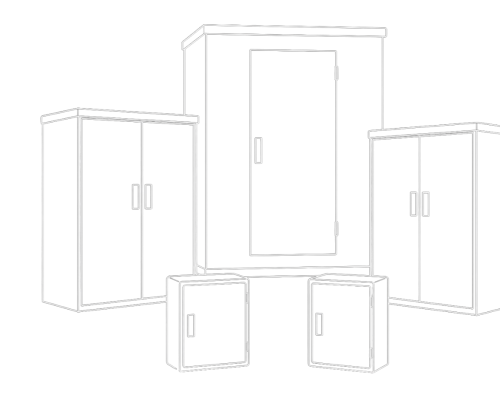
Europoly offers several product ranges, from small enclosures to large cabins, as well as bespoke designs. The full Europoly range includes, in particular, Micro Euro, Mini Euro, Euro Medium, Maxi Euro, Mega Euro, Euro Urbain and Euro Instrum.
Europoly’s projects also showcase applications in real-world conditions: the tropical environment in Kourou, irrigation in urban and saline environments, IRVE, industrial analysis and urban networks.
Maintenance may even involve refurbishment rather than replacement. Europoly therefore offers refurbishment services for existing polyester enclosures, including diagnostics, adaptation to new equipment and recommissioning.
Polyelec: integrating cabling into the solution
Choosing the right enclosure is only part of the project. Its electrical integration is just as important.
Polyelec, a company within the Europoly Group, specialises in the wiring of electrical cabinets and enclosures. This complementary approach enables Europoly to manufacture the polyester enclosure whilst Polyelec handles its wiring.
This approach enables us to offer a more comprehensive solution for applications such as EV charging points, photovoltaic systems, electrical switchboards and energy storage.
For outdoor installations, this makes it possible to work simultaneously on the enclosure, the layout of components, the cabling and thermal management.
Gensollen: protecting larger installations
Some installations require more than just a cabinet.
For automation, instrumentation or analytical equipment requiring a proper technical enclosure, Gensollen complements the Group’s range with cabins, shelters, technical enclosures and canopies made from glass-fibre-reinforced polyester.
In particular, solutions can be heat-insulated using sandwich panels combining polyester and polyurethane foam.
The reasoning remains the same: the more environmental conditions are taken into account right from the design stage, the easier it becomes to protect equipment in the long term and to organise its maintenance under the right conditions.
FAQ on the maintenance of electrical cabinets
The frequency depends on the environment, the manufacturers’ recommendations, the criticality of the equipment and the history of faults. It should be distinguished from the frequency of statutory inspections.
The casing, seals, cable entries, connections, wiring, ventilation equipment, temperature and any signs of damp or corrosion.
Glass-fibre-reinforced polyester is particularly suitable where the installation is exposed to damp or corrosion. However, the specific specifications must be selected according to the application.
No. Seals, fastenings, cable entries, fittings and modifications carried out during operation must always be checked.
Yes, in some cases. Europoly carries out refurbishment projects following an assessment of the existing cabinet. Whether this is feasible naturally depends on the cabinet’s condition and the new requirements.
The complementary nature of Europoly and Polyelec enables the manufacture of the polyester casing and the electrical wiring to be combined, thereby offering an integrated solution tailored to each project.
Conclusion
Proper maintenance of an electrical cabinet relies not only on regular checks, but also on analysing the causes when the same problems recur.
Corrosion, damp, condensation, overheating or premature deterioration may indicate that the enclosure is no longer suitable for the actual conditions at the site.
The initial choice therefore becomes crucial.
Thanks to its glass-fibre-reinforced polyester cabinets and enclosures, its various product ranges and its bespoke manufacturing capabilities, Europoly can meet the requirements of outdoor, damp, corrosive or technically demanding installations.
With Polyelec for cabling and Gensollen for polyester shelters and technical enclosures, the group can also undertake projects requiring a more comprehensive solution.
Do your maintenance checks regularly reveal problems with corrosion, damp, temperature or watertightness? Contact Europoly to discuss an enclosure tailored to the specific requirements of your installation.